

Let's cut right to the chase: buying a colored gem right now means wading through a swamp of fantastical marketing terminology. I am a gemologist and bench jeweler who stares at rough and faceted stones all day, but I spend a good chunk of my time translating vendor buzzwords into plain English for my clients. If you are hunting for a teal sapphire or a parti sapphire, you need to know exactly what you are paying for—because many stones currently marketed as "parti" simply aren't, and some marketed as teal are actually parti sapphire!
DISCLAIMER: Few things twist my tweezers quite like vendors using "parti," "peacock," and "mermaid" interchangeably, or worse, mashed together. It is gemological obfuscation at best. A parti-color sapphire is a stone with distinct, separate color zones built right into its crystal lattice. It is not just a sapphire that looks a bit blue from one side and green from another. Cute nicknames are only good if they are used correctly to describe a feature, used incorrectly, they can obscure the physical differences between an optical effect and actual color zoning. This matters when you are specifically searching for one over the other, once you begin searching, you realize it's probably easier to herd cats whilst blindfolded.


Peacock Mermaid or Mermaid Peacock? Who knows which version you'll get, who knows what that even means?
What Actually Makes a Sapphire "Parti"?
A true parti sapphire features two or more distinct colors present within the same crystal structure. Unlike gems that shift color based on lighting or viewing angle, a parti sapphire’s distinct color zones—like blue and yellow—are permanent, physical features of the stone.
When the corundum crystal was forming deep underground, the mineral soup surrounding it fluctuated. Trace elements dictate a sapphire's color. Iron and titanium create blue. Iron alone creates yellow or green. Chromium adds pink or purple. If the chemical environment shifted mid-growth, the crystal locked in those different elements in distinct bands or patches as time went on.
"A true parti sapphire is a geological timestamp. It is physical proof that the earth’s chemical environment changed its mind while the crystal was forming."

This means every single bi-color or parti sapphire is entirely unique. You cannot replicate the exact banding of a natural parti sapphire, though lab-growers are creating lab-grown parti sapphires that mimic this distinct zonal growth, with varying levels of success.
The Difference Between Parti and Pleochroism
The main point of confusion for the consumer in the jewelry industry is the conflation of color zoning and pleochroism.
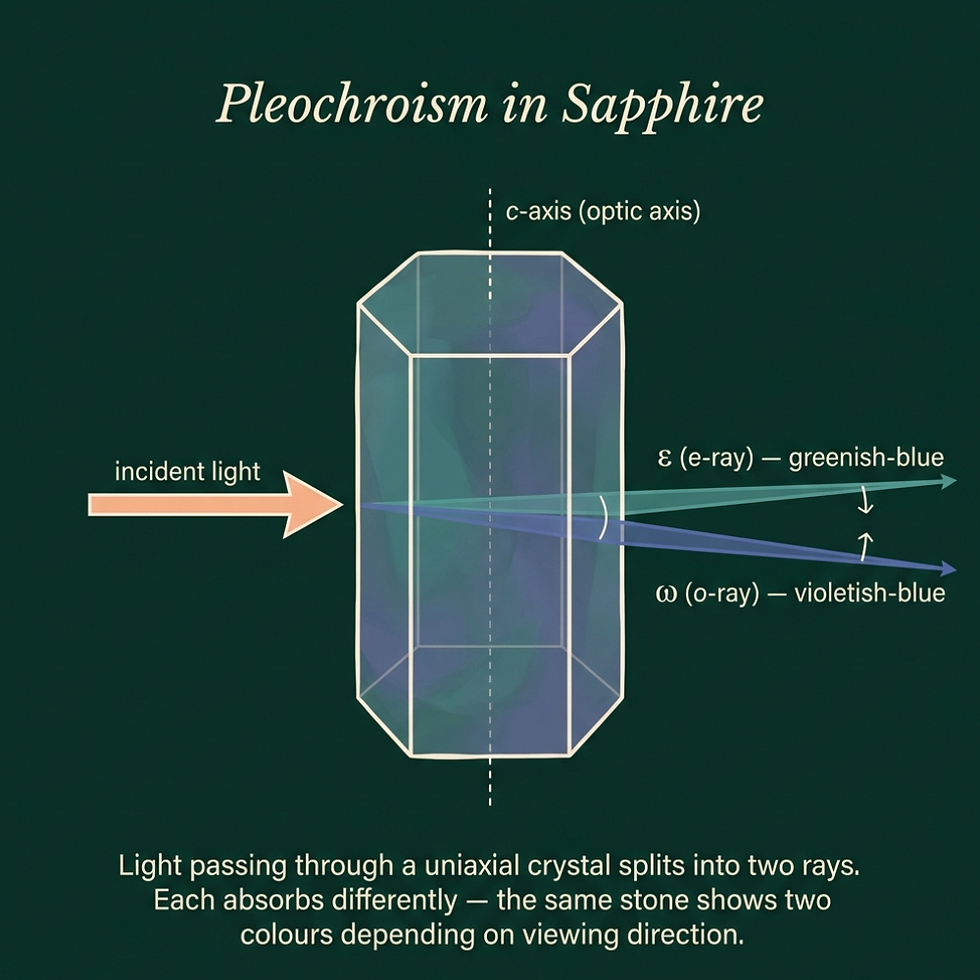
Sapphires are naturally pleochroic. Because of their crystal structure, they split light into different optical rays. This means a sapphire will show different colors depending on the physical angle from which you view it. A uniformly teal sapphire might show flashes of pure blue from the top, but look distinctly green or even purple when you tilt it to the side.
That is an optical effect. A true parti sapphire has physical zones of different colors, regardless of the angle.

Khay's Professional Experience and Insight
On the same day, I had two separate sapphires land on my bench, both with the word "peacock" scribbled on their parcel papers. The first was a uniformly teal Madagascar sapphire with intense pleochroism—flashing teal with sharp hits of purple depending on the viewing angle. The second "peacock" stone I evaluated that afternoon was a pear-cut parti sapphire, likely from Madagascar or Nigeria. The main body was teal, but the very tip of the pear was a distinct greenish-yellow. Face-up, that yellow tip reflected through the gem, giving the teal tones a beautifully mottled, multi-dimensional look. Marketing names alone will not tell you if a stone is a true parti or just highly pleochroic. When I assess a gem boasting teal hues or carrying a "mermaid" label, the first thing I do is flip it face-down onto its table facet. Looking directly into the pavilion—the gem's butt, if we are being technical—is one sure-fire way to clearly spot actual structural color zoning versus a crystal lattice based optical effect.
Decoding the Colors: Teal, Green, Purple, and Beyond
If we strip away the marketing fluff, there are a few main color combinations you will actually encounter in the wild.


Teal Sapphires
Colored gems are currently experiencing a renaissance in the bridal market, with these moody, oceanic beauties being the current darlings of the sapphire world. A true teal sapphire gives you that perfect, brooding marriage of deep blue and lush green, blended seamlessly throughout the crystal. There is no split personality or color blocking here—just a rich, unified wash of glorious blue-green saturation that commands a premium. Australian sapphires are known to posess teal tones with darker and lighter options.
Parti Sapphires
Parti sapphires are the rule-breakers of the corundum family. Instead of a uniform hue, these stones feature distinct, unapologetic zones of blue, yellow, or green within the exact same crystal. The real witchcraft happens on the stone cutter wheel; a clever gem cutter will align the facets so those separate zones either bounce light around internally, creating a chaotic, brilliant visual remix when viewed from the top, or illuminate the stark color division dramatically. Australia is historically famous for these heavily saturated bi-color and tri-color stones, and frankly, they absolutely refuse to be ignored.


Green and Yellow
Often hailing from iron-rich deposits, these stones feature deep, forest greens banded with vivid yellows. The contrast here can be incredibly striking, especially in step cuts that show off the distinct linear bands of color.
Purple and Blue (or Pink)
These are decidedly rarer. You might see a violet-blue body with a distinct pinkish-purple zone. These usually hail from Madagascar or Sri Lanka. Expecting to find a perfectly uniform 50/50 split of purple and blue is like expecting Imperial Stormtroopers to hit their target—it sounds great in theory, but it rarely happens in the real world.
Should you buy a starkly zoned bi-color sapphire, or one where the cutter successfully blended the zones into a mottled, shifting teal? There is no gemological right answer here. Some people want a sharp, visible split that proudly displays the stone's chaotic geological history. Others prefer the blended sparkle of a mixed-zone stone that shifts as it moves on the hand. The trade-off is purely visual. One offers graphic contrast; the other offers complex, shifting hues.
At the end of the day, you have to look at the stone and decide which aesthetic you want to stare at Let’s drop the obsession with the Mohs scale for a second. You aren't marrying a geology textbook, and you certainly aren't choosing a ring just because its carbon lattice can survive a nuclear blast. When you look down at your hand for the rest of your life, you shouldn't be thinking about scratch resistance or refractive indices. Besides, sapphire excels in those areas.

You want a stone that actually makes your breath catch. You need that defiant, wholly irrational little spark of magic that holds the exact gravity of your love story and reminds you why you said yes in the first place. Pick the gem that speaks directly to your soul, not just the one that passes a laboratory stress test. I can tell you if a stone is cut properly and structurally sound, but picking the color personality? Ultimately, that call rests squarely on your shoulders.
Takeaway:
True parti sapphires owe their multi-colored appearance to distinct chemical zones formed during crystal growth, not just the natural optical shifting of pleochroism. Evaluating these gems accurately means looking past marketing buzzwords and examining the physical color separation in the gem's pavilion. Whether you prefer a highly blended teal parti sapphire or a sharply defined bi-color gem comes down entirely to personal taste.
Have you ever flipped a colored gemstone upside down to see its true color structure, or do you rely only on the face-up sparkle??





Comments