


Updated: May 14
Let’s put the loupe down for a second and look at the raw facts: are multi-colored sapphires just poorly formed rejects that lapidaries couldn’t heat-treat into a uniform, marketable blue? Not by a long shot. They are highly sought-after geological anomalies, and treating them like a rinky dink renfaire trinket is a mindset as outdated as dial-up internet.
What Actually Is a Parti Sapphire?
A parti sapphire or parti color sapphire, is a single natural corundum crystal that displays two or more distinct colors—usually green, yellow, or blue—at the same time. This multi-colored effect is caused by distinct physical bands of trace elements that shifted while the rough crystal was forming deep underground.
DISCLAIMER: I'm just a wee bit shirty about a point of confusion that seems to be perpetuated from within the gem trade and I warn you, I'm armed with my spray bottle. A parti sapphire is not a color-change sapphire, nor is its primary feature pleochroism.
To be clear, all sapphires do possess some degree of pleochroism (a stone showing different colors from different viewing angles because of how light splits inside the crystal lattice), and this absolutely factors into faceting decisions on top of color zone placement. However, a parti sapphire has literal, physical bands of different colors built right into its atomic structure. If you chop a parti sapphire in half down the color line, you get two differently colored stones. Do that to a purely pleochroic stone, and you just have two smaller stones performing the exact same optical trick.
The Science of the Split (Why They Look Like That)
We need to talk about chemistry for a little bit, in a way that hopefully won't trigger high school exam flashbacks. Pure corundum is completely colorless. The rich colors we associate with sapphires are the result of trace elements crashing the crystal’s formation party.
When you introduce iron and titanium into the corundum lattice, this produces a rich blue color. If you introduce only iron, you get yellow or green, depending on the iron's oxidation state.
During the millions of years it takes a sapphire crystal to grow in a basaltic or metamorphic environment, the chemical soup surrounding it rarely stays the same. One century, the environment is rich in iron and titanium, laying down a band of deep blue. The next, the titanium drops out of the mix, and the crystal continues growing in a yellow band.
"A parti sapphire is essentially a geological tree ring, recording exact shifts in the earth's chemistry over thousands of years."

These shifts create distinct color zones within the rough stone. Sometimes the bands are sharp and highly defined. Other times, they transition smoothly, creating a gradient effect. The geological chaos is exactly what gives these stones their character.
Origins: Where Do These Stones Come From?
Not all corundum deposits produce parti sapphires. The presence of these stones requires specific trace element combinations that only exist in a few key locations globally.
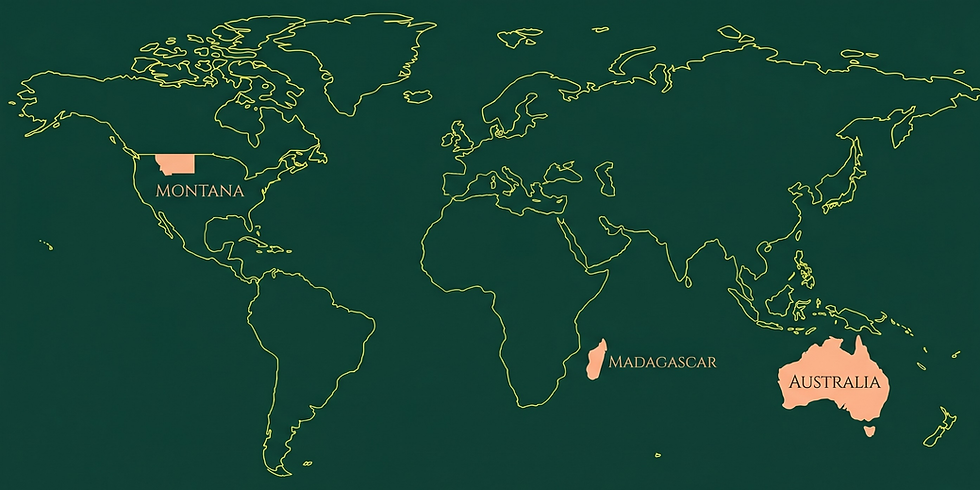

The Australian Heavyweights
By a big beefy country mile, Australia is the most prolific source of high-quality parti sapphires. The Central Queensland fields (like Rubyvale and Sapphire) and the New England region in New South Wales sit on ancient volcanic deposits. The basalts here are iron-rich, which is why Australian stones frequently feature strong, dominant bands of deep yellow and inky blue, often converging into striking green zones.
The Montana Pastels
Montana sapphires, specifically from the Rock Creek and Missouri River deposits, are famous for their unique steel-blue and seafoam green hues. While they produce fewer sharp-split parti sapphires than Australia, they do yield stunning heavily zoned stones. The colors here tend to be lighter, more pastel, and highly sought after by clients who prefer a softer visual aesthetic.
The Madagascar Alternatives
Madagascar has emerged as a major player in the global sapphire trade. The deposits in Ilakaka produce parti sapphires that frequently mimic the Australian color profiles. These stones are visually spectacular, though identifying the origin purely by eye is practically impossible without laboratory equipment analyzing the internal inclusion profiles.
Natural vs. Lab-Grown vs. Simulants
There's the odd but persistent rumor about some parti sapphires that are dyed or artificially created to trick buyers. Let’s clear the bench on this one.
Creating a multi-colored sapphire in a laboratory environment is technically difficult and financially counter-productive for most large-scale manufacturers. Parti sapphires, whilst valuable and rare, haven't got the historical 'prestige' associated with blue sapphires, so the fakery game hasn't really taken off (yet). The most common lab-grown method, flame fusion, uses a steady stream of chemical powder. Changing the chemical feed mid-growth to create sharp color zoning is erratic and highly prone to causing structural instability in the boule. While some flux-grown or hydrothermal lab sapphires can exhibit minor zoning, true parti-color lab sapphires with sharp, contrasting splits are exceptionally rare.
Because of this, a distinct, sharply zoned parti sapphire is one of the most reliable visual indicators that a stone is natural (though you should still demand a gemological report or get it tested).
One way you can help yourself is to watch out for simulants, because whilst they are rare in this category, it does happen. Glass can be manufactured with multiple colors easily. Doublets—where a slice of natural sapphire is glued to a larger piece of colored glass or synthetic sapphire—can also mimic a parti effect if the glue line is disguised by the setting. A trained gemologist will spot a doublet under magnification immediately by locating the adhesive plane or trapped gas bubbles, also the abrupt color change just screams simulant.
The Lapidary’s Dilemma: Cutting for Color
Finding a rough parti sapphire is only half the battle. The cutting pattern decisions made by the lapidary who cuts the stone dictates entirely whether the final gem looks like a masterpiece or a wishy washy, confused mess.
Trying to force a heavily zoned rough into a standard round brilliant cut without considering the internal color bands is like trying to convince an orc to trade his battle-axe for a lute—it just won’t end the way you want it to.

Cutting any sapphire requires orienting the table facet relative to the crystal's c-axis to manage pleochroism and maximize the best color. With a parti sapphire, the cutter has an extra layer of difficulty. They have to decide exactly where the color bands will sit inside the finished geometry of the stone. If they place the color split directly down the center of a brilliant-cut pavilion, the light bouncing around inside the gem will mix the blue and yellow zones together, and the stone will simply look greenish to the naked eye.
Khay's Professional Experience and Insight
Since all our manufacturing occurs in Auckland, New Zealand, we're never more than a 4-hour flight away from our trusted mining partners in Queensland, Australia where we source our parti color sapphires from. This means I have seen a cornucopia of stones, each one beautiful in its own way, and I regularly witness one of two truths when it comes to how these sapphires are cut;
The stones with clear, dramatic zoning are commonly cut in either emerald or octagon shapes, to preserve and emphasize the color split.
When the stone is too small or oddly shaped for this, more standard cuts are used but the parti effect is dimmed and you get more of a moody shifting of colors depending on the viewing direction.
An exception worth noting however, at 2-3ct in weight or over you can get away with some of the more traditional cuts whilst still preserving some of the visual effects of the color divide, but with a bit of 'blurring' of the color edges where facets meet and light gets thrown around. I have seen some excellent color placement in pear cuts with extremely dark points transitioning to light green or yellow at the bottom of the curve, so other shapes aren’t impossible, just rare.

Designing Around a Parti Sapphire
Mounting a single-color stone is a straightforward mathematical equation. Mounting a parti sapphire requires acknowledging that the metal you choose will actively change how the stone looks.
Metallurgy and Color Theory

Yellow gold acts as a visual amplifier for the yellow and green bands inside a parti sapphire. The warm metal reflects into the pavilion, pulling the lighter colors forward and making the stone look warmer overall.
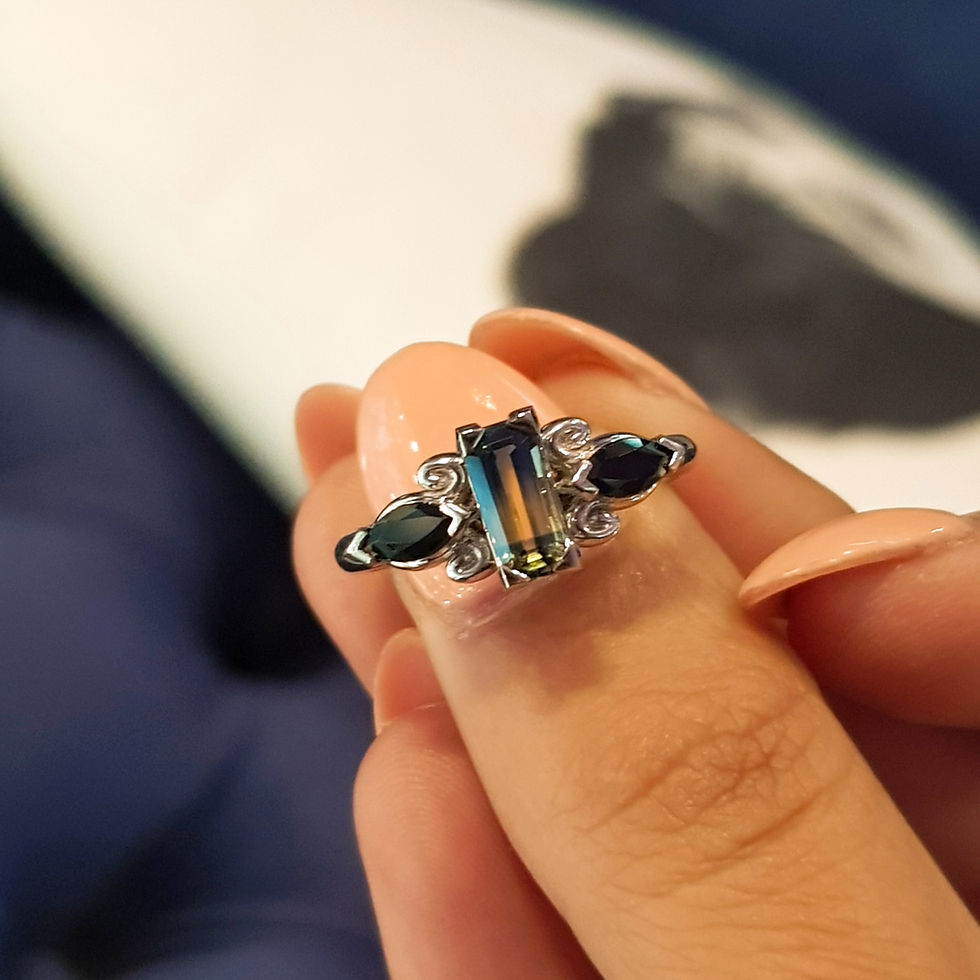
White gold or platinum does the opposite. Bright white metal highlights the titanium-rich blue zones, cooling the stone down visually and creating a stark, icy contrast against the yellow bands.
Rose gold sits somewhere in the middle, offering a complementary contrast to green zones while warming up the blues.
Setting Styles
The style of setting also impacts light performance. A full bezel setting completely wraps the girdle of the stone in metal. This offers maximum security against chipping, but it prevents light from entering the stone from the sides. For a dark Australian parti sapphire, a bezel can plunge the stone into shadow, obscuring the color split.
Prong settings allow light to enter from multiple angles, illuminating the internal zoning and making the separate colors much easier to distinguish on the hand.
I can tell you that an east-west set emerald-cut parti in a platinum prong setting maximizes color separation and light return perfectly. But ultimately, balancing metal color, security, and light performance is entirely your call to make based on your specific daily wear habits, and taste. If you want to find out more about this exceptional gem, check out our other articles.
Comments