top of page
HomeEduHubParti SapphireAre Parti Sapphires Valuable? Price, Cuts & Buying Guide
PARTI SAPPHIRE

Are Parti Sapphires Valuable? Price, Cuts & Buying Guide

By Khay · April 2026 · 6 min read

IN THIS GUIDE

6 articles in this series

Australian Sapphires: Characteristics, Ethics, Mining and More

6 min

Parti Sapphire Colors: Teal, Green, Purple & Bi-Color Gems

6 min

Parti Sapphire Meaning and Symbolism

5 min

Parti Sapphire Origins: Australian vs. Montana Sapphires

5 min

Parti Sapphire: The Complete Guide to these Multi-Colored Gems

6 min

GEM SANCTUM FIELD GUIDE

Add a Title

Add a Title

Add a Title

Add a Title

Add a Title

Add a Title

Add a Title

parti sapphire rough from australia.png

Are Parti Sapphires Valuable? Price, Cuts & Buying Guide

Are you throwing money away if you buy a sapphire that isn’t solid, uniform blue? Not by a long shot. The old-guard obsession with strictly monochromatic gemstones is fracturing. Parti sapphires—those multi-hued rebels of the corundum family—prove that striking beauty doesn’t require a single-color pedigree.

The Real Deal on Parti Sapphire Value

So, are parti sapphires valuable? Yes, but their value is calculated differently than traditional sapphires. Instead of prioritizing uniform saturation, gemologists look for a distinct, balanced display of two or more colors. A well-cut parti sapphire with high clarity and vivid color zoning commands premium prices, though any meaningful price gap between a premium parti and a top-tier pure blue really only rears its head when you start dealing with absolute boulders.

DISCLAIMER:

If there is one piece of industry fiction that makes my eye twitch, it is the persistent notion that parti sapphires are “reject” stones. Some traditionalists still peddle the narrative that these bi-color gems are low-grade corundum that failed to achieve a uniform hue. That is a notion stinkier than last week's diapers. Why would a phenomena that is genuinely rare produce a worthless rock, when single color varieties easily top thousands of dollars per carat regularly? The idea makes about as much sense as a screen door on a submarine. Someone is telling porkies, and it's not me.


What Causes the Color Chaos?

Let’s put our cards on the table: understanding sapphire value starts with some basic chemistry. Corundum (the scientific name for sapphire), is naturally colorless. When iron and titanium crash the party during crystal formation, you get blue. Throw in some iron, and you get yellow or green.

In a parti sapphire, the environment shifted while the crystal was forming. The trace elements didn’t mix evenly, resulting in distinct color zoning. We see this frequently in material sourced from Australia, Montana, and occasionally Madagascar.

Pricing Factors: How We Value the Asymmetry

If you are evaluating a traditional blue sapphire, you want the color to be as evenly distributed as possible. Any zoning drops the price. With parti sapphires, we flip the script. The zoning is the feature.

Here is how I evaluate them at the workbench:


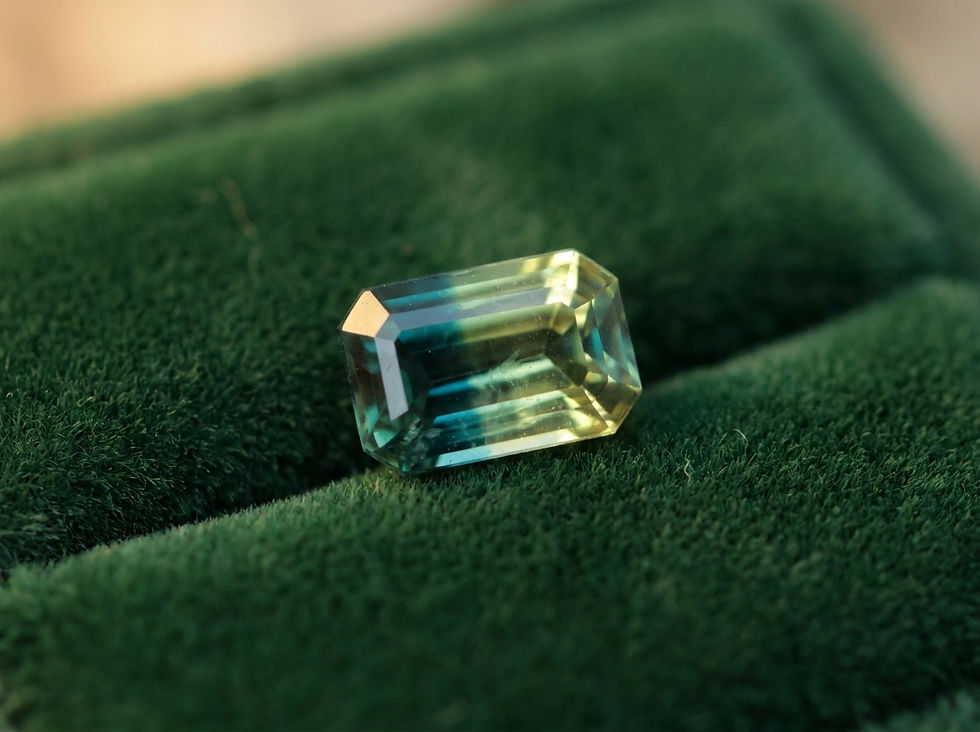
a green and yellow parti color sapphire in emerald cut sitting on grass green velvet jewelry display

Color Separation:

The most valuable parti sapphires have sharp, distinct borders between the colors. A crisp 50/50 split of blue and yellow, or a stark tri-color layout, fetches a premium, these are exceedingly rare. If the colors bleed together too much, the stone just looks like a murky swamp, and the value drops accordingly.

Clarity: Because you are paying for the visual contrast of the color zones, high clarity is non-negotiable. Heavy silk or distracting inclusions mask the color separation.

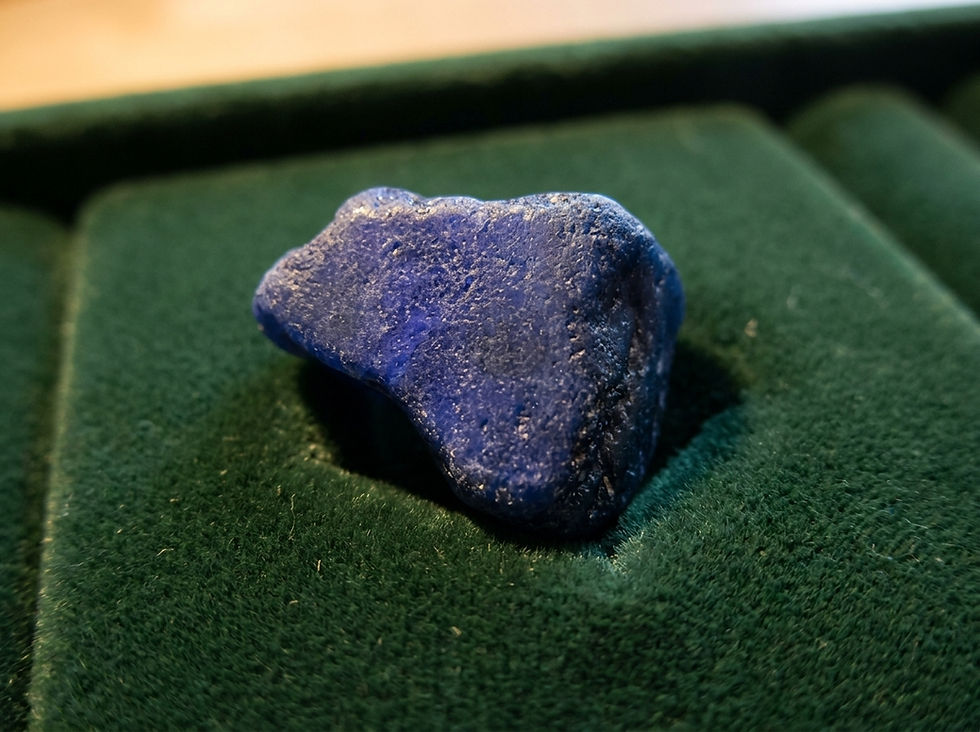
This image of a rough sapphire illustrates perfectly the challenges with evaluating rough. To the untrained eye, its a dull blue rock, the only way to know for sure is to polish in a 'window' and see if there's even a small section of facet quality clarity inside this rough.

a large cobalt blue piece of sapphire rough that is mostly opaque

Carat Weight: Finding a clean piece of rough with distinct color zoning large enough to yield a heavy faceted stone is rare, and prices jump sharply once you cross the two-carat threshold. Even so, parti color sapphires still typically sit 25–40% lower per carat than commercial Ceylon or African blue sapphire of comparable size and clarity — and the gap widens further against ruby or emerald. You're getting the same corundum species your prestige blue cousins are cut from, in a more interesting palette, for a fraction of the going rate.

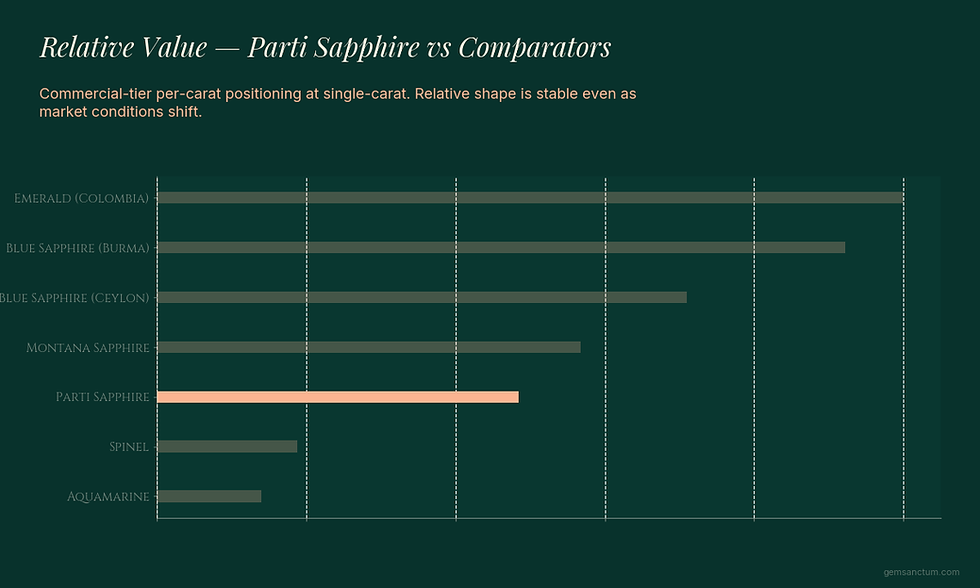
Per-carat value comparison at one carat: parti sapphire sits between
spinel and montana sapphire, well below commercial Ceylon blue, Burma blue,
and emerald.
Same corundum species as blue sapphire, yet parti's commercial per-carat price sits closer to spinel and Montana — well below Ceylon Sapphire, Burmese Sapphire or Emeralds.

I'll remind you here that jewelry is bought to be worn and enjoyed. I never treat or discuss gemstones as financial assets meant to appreciate, and neither should anyone selling them to you. You buy a parti sapphire because you love the aesthetic, full stop. The only exception sits in the top 0.001% of cut gemstones — genuinely investment-grade, museum-grade stones with either historical provenance, exceptional size, or both.

Choosing Your Parti Sapphire: What to Look For

Buying a bi-color or parti sapphire requires throwing out the traditional diamond grading rulebook. You are not looking for total uniformity. You are looking for a stone that does something interesting with light. Sapphire is not like diamond where you're looking for flashes of light, the whole 'point' of colored stones is, well, color. We care about light for the job it does in throwing that color around.

a graph showing sapphire's light performance as brilliance, compared to other gems like diamond and spinel

As you can see here, brilliance is only a side-quest on this gemstone journey, colored gemstones priorites lie in hue and saturation, and for parti sapphire, color zones.


Cut Dictates Personality

With a parti sapphire, the stone cutter’s job is not just about maximizing carat weight; it is about managing the color zones. A skilled cutter will place the color zones strategically relative to the culet (the bottom point). Sometimes they aim to blend the colors face-up, creating a shifting, mottled appearance. Other times, they orient the table facet directly over a harsh color line to create a stark, graphic split right down the middle of the gem.
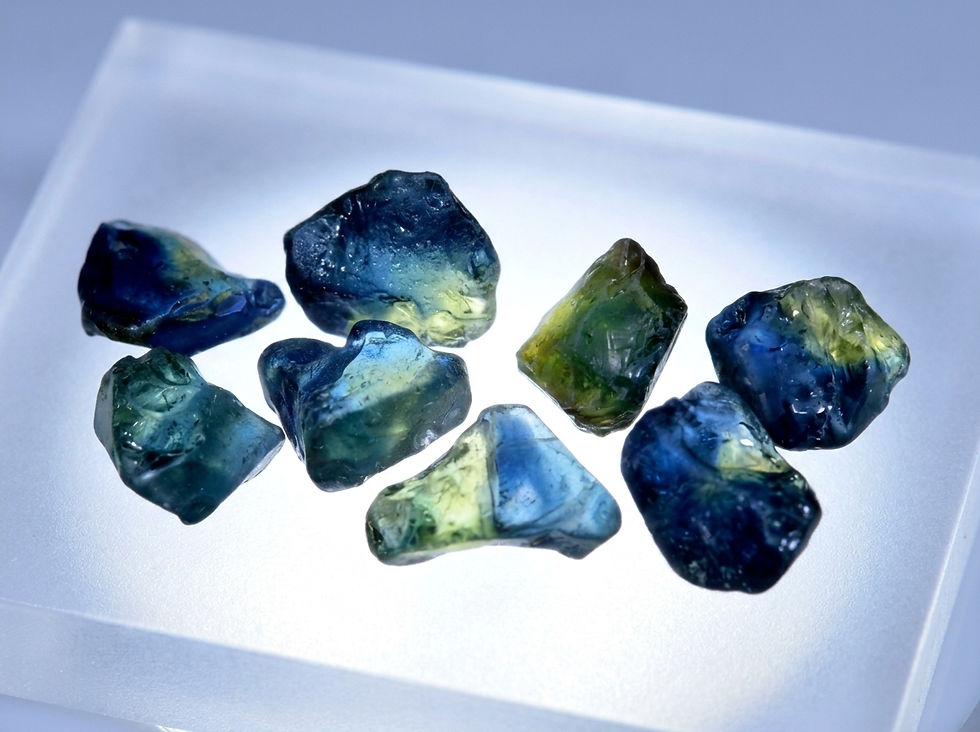
rough parti color sapphire on a light table, clearly delineated zones of blue and yellow visible.
It takes a highly skilled gem cutter to extract the beauty from this sort of challenging geometry, with carefully executed facets.

Clarity Considerations

You generally want an eye-clean stone, meaning no inclusions visible to the naked eye. But there is a catch: the color zoning itself can sometimes look like internal structural lines (growth planes). Do not mistake a sharp, straight color zone for a cleavage plane or an internal flaw.

Symmetry and Light Return

Look for good light return across the whole face of the gem. If a stone has a massive "window"—a dead, see-through spot in the center where light leaks straight out the back—the beautiful parti effect gets completely lost. You want brilliance that pushes those distinct colors back up to your eye.

Because the cutter has to orient the gem to showcase the color zoning favorably, step cuts (like emerald or radiant cuts) are the traditional go-to. Step cuts feature long, parallel facets that act like distinct windows. They allow you to clearly see the color boundaries without the fragmented light return of a brilliant cut scrambling the hues.

Khay's Professional Experience and Insight

We do see one notable exception to the step-cut dominance in the parti world. It depends entirely on the geographical layout of the color zones within the rough material. We call this color placement the "Pharaoh's Eye," and yes, it is exactly as impressive as it sounds.

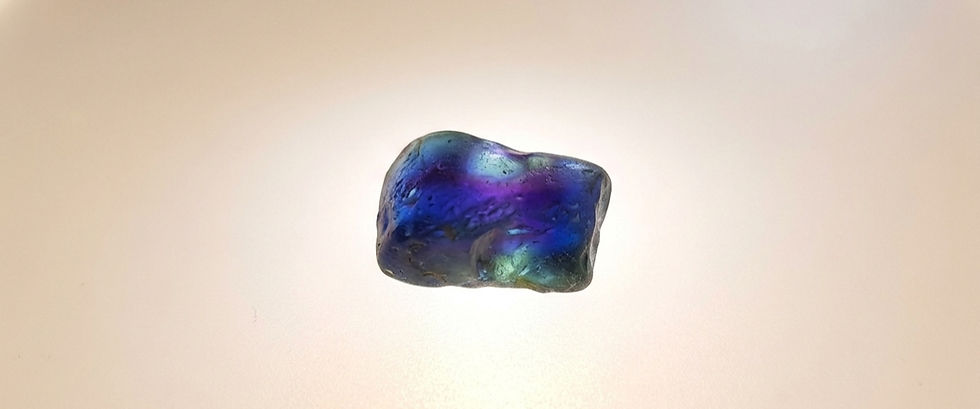
a piece of rough parti color sapphire gem on a light table, exhibiting deep cobalt blues and green patches
if the greenish yellow spots were oriented toward the middle of the stone, we would have a perfect candidate here for a 'pharoah's eye' type of cut, instead we have a great example of the usual 'motley' parti color zoning.

In the rough, this material usually presents as an almost solid blue chunk with a tiny, sharply defined zone of yellow right near the center. If the cleavage planes and rough shape permit, a highly skilled cutter can orient the stone so that tiny yellow zone sits dead center. Look at it face-up in a round brilliant or modified round facet pattern, and the central yellow completely explodes. It throws intense light back at the viewer while perfectly framed by an ombre-like blue border around the outer facets, similar to the limbal ring around the iris of your eye. Tilt the stone slightly off-axis, and boom—it appears entirely blue. It is a massive show-stopper of an optical phenomenon. Realistically, this is the only scenario where I am genuinely thrilled to see a parti sapphire faceted into a round shape.

Sourcing and Daily Wearability

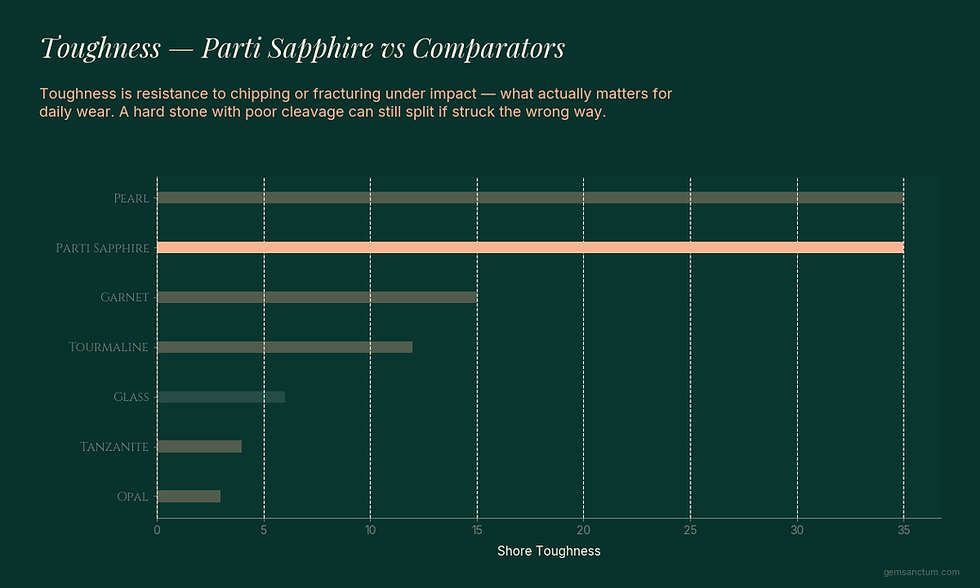
Sapphires sit at a 9 on the Mohs hardness scale. They are tougher than almost anything else you will encounter on a daily basis. They have excellent toughness and lack the distinct cleavage planes that make diamonds vulnerable to shearing impacts. If you are envisioning an engagement ring or a piece for daily wear, a parti sapphire is a solid choice, as well as being beautiful.

sapphire toughness chart compared to other gems

Currently, Australia remains the heavy hitter for distinct blue, green, and yellow combinations. Montana sapphires frequently yield softer, steely blue-green transitions. Madagascar is also producing exceptional material, often with razor-sharp color contrasts, although less commonly than Australia.

When you are hunting for yours, ask to see the stone in different lighting environments. A true parti will hold its own under daylight versus incandescent indoor bulbs.

You have to weigh the chaotic beauty of a parti against the classic, uniform elegance of a traditional sapphire. Both are scientifically magnificent, but at the end of the day, the choice of what sits on your finger is entirely up to you, to find out a bit more about this dynamic gem, click here.

Takeaway: Parti sapphires derive their value from distinct, high-contrast color zoning rather than uniform saturation. While they command lower prices than elite pure blue corundum, top-tier parti sapphires with excellent clarity and masterful cuts are highly sought-after, and genuinely rare.

Does the unpredictable color zoning of a parti sapphire appeal to you, or do you prefer the classic uniformity of a traditional gem?

KHAY

Gemologist & Goldsmith · Auckland, New Zealand

15+ years working with coloured gemstones. I write these guides from the bench — every claim is something I've tested with my own tools.

case study

Add a Title

gemline

excerpt

VIEW THIS COMMISSION →

EXPLORE THE COLLECTION

See {Gem Name} in the Inventory

Add paragraph text. Click “Edit Text” to update the font, size and more. To change and reuse text themes, go to Site Styles.

BEGIN A CUSTOM COMMISSION

EXPLORE MORE

Add a Title

Add paragraph text. Click “Edit Text” to update the font, size and more. To change and reuse text themes, go to Site Styles.

Add a Title

Add paragraph text. Click “Edit Text” to update the font, size and more. To change and reuse text themes, go to Site Styles.

Add a Title

Add paragraph text. Click “Edit Text” to update the font, size and more. To change and reuse text themes, go to Site Styles.

  • Apr 22
  • 6 min read

Updated: 5 days ago

Are Parti Sapphires Valuable? Price, Cuts & Buying Guide

Are you throwing money away if you buy a sapphire that isn’t solid, uniform blue? Not by a long shot. The old-guard obsession with strictly monochromatic gemstones is fracturing. Parti sapphires—those multi-hued rebels of the corundum family—prove that striking beauty doesn’t require a single-color pedigree.

The Real Deal on Parti Sapphire Value

So, are parti sapphires valuable? Yes, but their value is calculated differently than traditional sapphires. Instead of prioritizing uniform saturation, gemologists look for a distinct, balanced display of two or more colors. A well-cut parti sapphire with high clarity and vivid color zoning commands premium prices, though any meaningful price gap between a premium parti and a top-tier pure blue really only rears its head when you start dealing with absolute boulders.

DISCLAIMER:

If there is one piece of industry fiction that makes my eye twitch, it is the persistent notion that parti sapphires are “reject” stones. Some traditionalists still peddle the narrative that these bi-color gems are low-grade corundum that failed to achieve a uniform hue. That is a notion stinkier than last week's diapers. Why would a phenomena that is genuinely rare produce a worthless rock, when single color varieties easily top thousands of dollars per carat regularly? The idea makes about as much sense as a screen door on a submarine. Someone is telling porkies, and it's not me.


What Causes the Color Chaos?

Let’s put our cards on the table: understanding sapphire value starts with some basic chemistry. Corundum (the scientific name for sapphire), is naturally colorless. When iron and titanium crash the party during crystal formation, you get blue. Throw in some iron, and you get yellow or green.

In a parti sapphire, the environment shifted while the crystal was forming. The trace elements didn’t mix evenly, resulting in distinct color zoning. We see this frequently in material sourced from Australia, Montana, and occasionally Madagascar.

Pricing Factors: How We Value the Asymmetry

If you are evaluating a traditional blue sapphire, you want the color to be as evenly distributed as possible. Any zoning drops the price. With parti sapphires, we flip the script. The zoning is the feature.

Here is how I evaluate them at the workbench:


a green and yellow parti color sapphire in emerald cut sitting on grass green velvet jewelry display

Color Separation:

The most valuable parti sapphires have sharp, distinct borders between the colors. A crisp 50/50 split of blue and yellow, or a stark tri-color layout, fetches a premium, these are exceedingly rare. If the colors bleed together too much, the stone just looks like a murky swamp, and the value drops accordingly.

Clarity: Because you are paying for the visual contrast of the color zones, high clarity is non-negotiable. Heavy silk or distracting inclusions mask the color separation.

This image of a rough sapphire illustrates perfectly the challenges with evaluating rough. To the untrained eye, its a dull blue rock, the only way to know for sure is to polish in a 'window' and see if there's even a small section of facet quality clarity inside this rough.

a large cobalt blue piece of sapphire rough that is mostly opaque

Carat Weight: Finding a clean piece of rough with distinct color zoning large enough to yield a heavy faceted stone is rare, and prices jump sharply once you cross the two-carat threshold. Even so, parti color sapphires still typically sit 25–40% lower per carat than commercial Ceylon or African blue sapphire of comparable size and clarity — and the gap widens further against ruby or emerald. You're getting the same corundum species your prestige blue cousins are cut from, in a more interesting palette, for a fraction of the going rate.

Per-carat value comparison at one carat: parti sapphire sits between
spinel and montana sapphire, well below commercial Ceylon blue, Burma blue,
and emerald.
Same corundum species as blue sapphire, yet parti's commercial per-carat price sits closer to spinel and Montana — well below Ceylon Sapphire, Burmese Sapphire or Emeralds.

I'll remind you here that jewelry is bought to be worn and enjoyed. I never treat or discuss gemstones as financial assets meant to appreciate, and neither should anyone selling them to you. You buy a parti sapphire because you love the aesthetic, full stop. The only exception sits in the top 0.001% of cut gemstones — genuinely investment-grade, museum-grade stones with either historical provenance, exceptional size, or both.

Choosing Your Parti Sapphire: What to Look For

Buying a bi-color or parti sapphire requires throwing out the traditional diamond grading rulebook. You are not looking for total uniformity. You are looking for a stone that does something interesting with light. Sapphire is not like diamond where you're looking for flashes of light, the whole 'point' of colored stones is, well, color. We care about light for the job it does in throwing that color around.

a graph showing sapphire's light performance as brilliance, compared to other gems like diamond and spinel

As you can see here, brilliance is only a side-quest on this gemstone journey, colored gemstones priorites lie in hue and saturation, and for parti sapphire, color zones.


Cut Dictates Personality

With a parti sapphire, the stone cutter’s job is not just about maximizing carat weight; it is about managing the color zones. A skilled cutter will place the color zones strategically relative to the culet (the bottom point). Sometimes they aim to blend the colors face-up, creating a shifting, mottled appearance. Other times, they orient the table facet directly over a harsh color line to create a stark, graphic split right down the middle of the gem.

rough parti color sapphire on a light table, clearly delineated zones of blue and yellow visible.
It takes a highly skilled gem cutter to extract the beauty from this sort of challenging geometry, with carefully executed facets.

Clarity Considerations

You generally want an eye-clean stone, meaning no inclusions visible to the naked eye. But there is a catch: the color zoning itself can sometimes look like internal structural lines (growth planes). Do not mistake a sharp, straight color zone for a cleavage plane or an internal flaw.

Symmetry and Light Return

Look for good light return across the whole face of the gem. If a stone has a massive "window"—a dead, see-through spot in the center where light leaks straight out the back—the beautiful parti effect gets completely lost. You want brilliance that pushes those distinct colors back up to your eye.

Because the cutter has to orient the gem to showcase the color zoning favorably, step cuts (like emerald or radiant cuts) are the traditional go-to. Step cuts feature long, parallel facets that act like distinct windows. They allow you to clearly see the color boundaries without the fragmented light return of a brilliant cut scrambling the hues.

Khay's Professional Experience and Insight

We do see one notable exception to the step-cut dominance in the parti world. It depends entirely on the geographical layout of the color zones within the rough material. We call this color placement the "Pharaoh's Eye," and yes, it is exactly as impressive as it sounds.

a piece of rough parti color sapphire gem on a light table, exhibiting deep cobalt blues and green patches
if the greenish yellow spots were oriented toward the middle of the stone, we would have a perfect candidate here for a 'pharoah's eye' type of cut, instead we have a great example of the usual 'motley' parti color zoning.

In the rough, this material usually presents as an almost solid blue chunk with a tiny, sharply defined zone of yellow right near the center. If the cleavage planes and rough shape permit, a highly skilled cutter can orient the stone so that tiny yellow zone sits dead center. Look at it face-up in a round brilliant or modified round facet pattern, and the central yellow completely explodes. It throws intense light back at the viewer while perfectly framed by an ombre-like blue border around the outer facets, similar to the limbal ring around the iris of your eye. Tilt the stone slightly off-axis, and boom—it appears entirely blue. It is a massive show-stopper of an optical phenomenon. Realistically, this is the only scenario where I am genuinely thrilled to see a parti sapphire faceted into a round shape.

Sourcing and Daily Wearability

Sapphires sit at a 9 on the Mohs hardness scale. They are tougher than almost anything else you will encounter on a daily basis. They have excellent toughness and lack the distinct cleavage planes that make diamonds vulnerable to shearing impacts. If you are envisioning an engagement ring or a piece for daily wear, a parti sapphire is a solid choice, as well as being beautiful.

sapphire toughness chart compared to other gems

Currently, Australia remains the heavy hitter for distinct blue, green, and yellow combinations. Montana sapphires frequently yield softer, steely blue-green transitions. Madagascar is also producing exceptional material, often with razor-sharp color contrasts, although less commonly than Australia.

When you are hunting for yours, ask to see the stone in different lighting environments. A true parti will hold its own under daylight versus incandescent indoor bulbs.

You have to weigh the chaotic beauty of a parti against the classic, uniform elegance of a traditional sapphire. Both are scientifically magnificent, but at the end of the day, the choice of what sits on your finger is entirely up to you, to find out a bit more about this dynamic gem, click here.

Takeaway: Parti sapphires derive their value from distinct, high-contrast color zoning rather than uniform saturation. While they command lower prices than elite pure blue corundum, top-tier parti sapphires with excellent clarity and masterful cuts are highly sought-after, and genuinely rare.

Does the unpredictable color zoning of a parti sapphire appeal to you, or do you prefer the classic uniformity of a traditional gem?


Comments


bottom of page